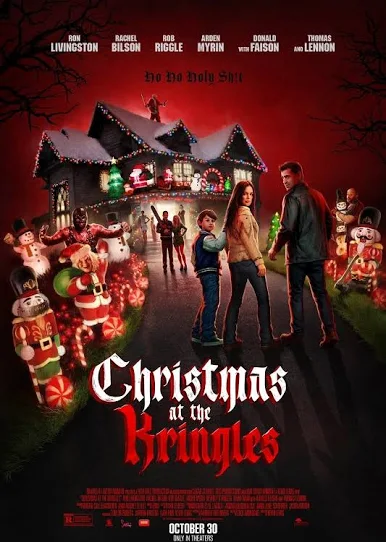
There is something particularly disappointing about a movie that has all the ingredients for a wonderfully ridiculous experience but cannot figure out how to bring them together. A talented ensemble cast, a sinister Christmas cult, and a premise that practically invites outrageous humor should have made Christmas at the Kringles an entertaining addition to the holiday horror genre. Instead, director Kevin Lewis delivers a film that feels more like an unfinished rough cut than a polished theatrical release.
I was genuinely excited about this one. The trailer suggested a tongue-in-cheek Christmas horror comedy that embraced its absurdity, and with this particular collection of comedic performers, there was every reason to expect something entertaining. I wasn’t looking for sophisticated storytelling or groundbreaking horror. I wanted a movie that understood its ridiculous premise and knew how to have fun with it.
Unfortunately, Christmas at the Kringles never finds that balance. What should have been a chaotic celebration of holiday horror becomes an exhausting exercise in improvisation, awkward editing, and filmmaking that struggles to establish any sense of direction.
A Christmas Horror Comedy With a Promising Premise
The story follows the Seversons, a married couple hoping to repair their troubled relationship after relocating from the city to a suburban neighborhood shortly before Christmas. Their new surroundings initially appear welcoming, particularly when they meet the Kringles, an excessively cheerful family whose enthusiasm for Christmas extends well beyond the holiday season.
But the Kringles aren’t simply enthusiastic neighbors with an unhealthy attachment to Christmas decorations. They’re members of a sinister holiday cult determined to recruit new followers, with potentially deadly consequences for anyone unwilling to embrace their beliefs.
It’s an amusing concept, particularly when considering how easily the traditions of wholesome Christmas entertainment could be twisted into something disturbing. There’s an opportunity to explore the absurdity of forced holiday cheer, the uncomfortable expectations of suburban conformity, and the increasingly ridiculous behavior of people who take Christmas traditions far too seriously.
Unfortunately, the movie seems more interested in getting from one predetermined story beat to another than developing the possibilities within its premise. The narrative moves forward, but the individual scenes rarely build on one another in a meaningful or entertaining way. What should become an increasingly outrageous series of encounters instead feels like a collection of ideas that never quite connect.
A Talented Cast Without Comedic Rhythm
Perhaps the film’s greatest disappointment is its ensemble cast. Ron Livingston, Rachel Bilson, Thomas Lennon, Arden Myrin, Rob Riggle, and Donald Faison bring considerable experience to the production, and several are particularly accomplished improvisational performers. Their enthusiasm is evident, and there are occasional one-liners that genuinely made me laugh. Unfortunately, those moments appear to come from the individual talents of the actors rather than the way the scenes have been constructed.
Much of the movie feels as though the filmmakers assembled a group of talented comedians, turned on the cameras, and allowed them to entertain themselves. The resulting performances are energetic, but that energy rarely translates into effective comedy.
Improvisation can be an extraordinary filmmaking tool when handled properly. Christopher Guest demonstrated its effectiveness in films such as Best in Show and Waiting for Guffman, while Paul Feig has successfully incorporated improvisational performances into carefully structured studio comedies. What makes those films work isn’t simply the talent of their performers. It’s the understanding that improvisation still requires direction, structure, and an editor who recognizes comedic timing.
Those fundamentals are largely absent here. Conversations wander, performers talk over one another, and scenes continue long after their jokes have exhausted whatever humor they initially contained. The editing rarely establishes the rhythm necessary for a joke to land, leaving the audience watching talented actors struggle against the structure of the film itself.
At times, it feels as though everyone involved is enjoying a joke that the audience was never invited to participate in.
That’s an unfortunate position for any comedy, particularly one built around performers who have demonstrated their abilities elsewhere. The problem isn’t a lack of talent. It’s the absence of a cohesive approach capable of bringing that talent together.
Low-Budget Filmmaking That Never Establishes Its World
The film’s visual presentation creates another significant obstacle. Despite taking place in a suburban neighborhood, Christmas at the Kringles rarely establishes a convincing sense of its environment. Even exterior sequences feel strangely confined, with an abundance of medium shots, close-ups, and reaction shots replacing the wider compositions that might have helped establish the community surrounding these characters.
The result is a movie that often resembles a student production featuring recognizable professional actors. That comparison isn’t intended as a dismissal of independent filmmaking or limited budgets. Some remarkable movies have been created with very little money. But financial limitations don’t automatically prevent filmmakers from establishing geography, developing atmosphere, or making deliberate visual choices that contribute to the storytelling.
Here, the camera frequently seems concerned with capturing whatever action is happening immediately in front of it rather than creating a convincing world around the characters. The blocking is conventional, the environments feel restricted, and occasional stylistic flourishes, including unusual camera angles and slow motion, seem disconnected from the narrative.
Cinematographer Brandon Cox introduces exaggerated reds, greens, and blues that give portions of the movie a distinctly festive appearance. Those colors occasionally suggest the surreal Christmas atmosphere the film appears to be pursuing, but they cannot compensate for the production’s overall lack of visual cohesion.
It’s particularly disappointing because the central premise offers considerable opportunities for atmospheric filmmaking. A seemingly ordinary neighborhood concealing a dangerous Christmas cult could gradually transform familiar holiday imagery into something unsettling. Instead, the setting rarely becomes more than a backdrop for extended conversations and comedic exchanges.
The horror itself is similarly underdeveloped. Although the movie includes occasional moments of violence, there is little sustained suspense or particularly inventive use of its sinister holiday premise. Rather than balancing horror with comedy, the film spends much of its running time relying on dialogue that struggles to generate either laughter or tension.
Kevin Lewis Struggles to Control the Chaos
Director Kevin Lewis previously explored outrageous genre filmmaking with Willy’s Wonderland, a deliberately absurd film featuring Nicolas Cage battling murderous animatronic characters. That movie understands its unusual premise and commits to it with a consistent sense of identity. Its ridiculousness is part of the experience, but the film doesn’t constantly appear to be demanding that audiences recognize how outrageous it is.
Christmas at the Kringles takes a different approach, seemingly determined to establish itself as an eccentric cult comedy through increasingly exaggerated performances and situations. Unfortunately, outrageous behavior alone doesn’t make something entertaining, and a movie cannot manufacture a cult following simply by presenting itself as deliberately ridiculous.
The film’s most significant weakness is its lack of restraint. Lewis has assembled a collection of capable performers, but the finished movie never demonstrates the control necessary to shape their individual contributions into a satisfying experience. It’s like having an orchestra full of talented musicians without anyone conducting.
Independent filmmaking undoubtedly presents difficult challenges, particularly when productions operate under compressed schedules and limited resources. Those circumstances deserve consideration, but they don’t erase the importance of effective storytelling, thoughtful editing, and disciplined performances.
The finished film ultimately has to stand on its own merits, and Christmas at the Kringles struggles to do so.
Final Thoughts: A Disappointing Holiday Horror Movie
What makes Christmas at the Kringles so frustrating isn’t simply that it fails as a comedy or that its horror elements are underwhelming. It’s that the potential for something genuinely entertaining remains visible throughout the experience.
There are moments when an actor delivers an amusing line, when the absurdity of the premise briefly suggests a more successful movie, or when the festive cinematography hints at the atmosphere the filmmakers might have created. But those isolated moments never develop into anything substantial.
I could easily imagine a version of this story that embraces its ridiculous Christmas cult premise while maintaining the comedic discipline necessary to make its increasingly outrageous situations entertaining. With tighter editing, stronger visual storytelling, and a clearer understanding of when to let its performers explore and when to move forward, this might have become the kind of unconventional holiday comedy audiences return to year after year.
Unfortunately, that’s not the movie I watched.
I didn’t leave the theater angry. I left disappointed. There’s a particular frustration in watching a promising idea and a terrific cast struggle through a movie that never seems to find its footing.
The trailer promised a polished, unhinged Christmas horror comedy. What arrived on screen felt like an unfinished assembly of ideas still searching for the movie they were supposed to become.
For me, Christmas at the Kringles is a wasted opportunity. Its cast deserved stronger material, its premise deserved more imagination, and its audience deserved a movie that understood how to turn all that potential into something entertaining.
Sometimes the most disappointing movies aren’t the ones with nothing to offer. They’re the ones that have so much going for them and somehow fail to make any of it work.
Leave a Reply